Office Cleaning Is About Maintenance, Not Restoration | Budget Cleaning
Part 1: What Can Really Be Cleaned in 3 Hours?
A Practical Guide to Office Cleaning Expectations in Singapore
One of the biggest frustrations in office cleaning isn’t poor workmanship—it’s mismatched expectations. This guide explains what a professional cleaner can realistically accomplish during a three-hour maintenance visit, why some tasks take longer than others, and how understanding the scope of work helps keep your office consistently clean.
The Most Common Question We Get
“Can one cleaner clean our entire office in just three hours?”
The short answer is yes—but only if everyone understands what routine office cleaning is actually designed to achieve.
At first glance, three hours may sound like plenty of time. However, professional office cleaning is, in many ways, a matter of time management. Every cleaning session has a fixed number of minutes. The goal isn’t to do everything—it is to prioritise the tasks that have the greatest impact on hygiene, safety, and workplace presentation.
The Cleaning Math Problem
Every minute spent on one task is a minute that cannot be spent somewhere else. For example, spending an additional 20 minutes cleaning the inside of a pantry refrigerator means there are 20 fewer minutes available for vacuuming floors, cleaning washrooms, or sanitising frequently touched surfaces.
Professional office cleaning is therefore about making the best use of the available time, not simply working faster. Rather than attempting every possible cleaning task during every visit, professional cleaning plans focus on maintaining the areas employees use every day, while scheduling more labour-intensive work separately.
Many misunderstandings between cleaning companies and clients don’t happen because the cleaning wasn’t done well. They happen because expectations and available cleaning time simply don’t match.
This guide answers three of the questions we hear most often:
To make this guide practical, we will use a baseline layout of an 800 sq ft office. While every workspace is different, the principles discussed here apply to offices of many different sizes:
Office Cleaning Is About Maintenance, Not Restoration
One of the biggest misconceptions about office cleaning is the belief that every visit should leave the workplace looking as though it has just undergone a complete deep clean. In reality, that’s neither practical nor necessary.
Professional office cleaning is built around planned maintenance, not intensive restoration.
🚗 Think of Office Cleaning Like Maintaining a Car
You don’t replace the tyres every month or service the engine every week.
Instead, different maintenance tasks are carried out at appropriate intervals to keep the vehicle running reliably.
Office cleaning works exactly the same way.
High-Frequency Maintenance
Some tasks need to be completed every visit because they directly affect workplace hygiene and employee comfort.
Low-Frequency Rotations
Others require attention less frequently because dirt and dust build up much more slowly over time.
Trying to complete every single cleaning task during every visit is neither cost-effective nor an efficient use of time. Instead, routine office cleaning focuses on maintaining cleanliness before dirt has the opportunity to accumulate into a larger problem.
Not All Offices Are Created Equal
One of the biggest mistakes people make when estimating office cleaning time is assuming that floor area tells the whole story. It doesn’t. Two offices can both measure exactly 800 square feet yet require vastly different amounts of actual work.
| Feature | Office A (Lower Cleaning Demand) | Office B (Higher Cleaning Demand) |
|---|---|---|
| Number of Employees | 6 | 18 |
| Layout | Open-plan office | Multiple enclosed offices |
| Pantry Usage | Light | Heavy throughout the day |
| Meeting Rooms | One | Frequent client meetings |
| Visitor Traffic | Occasional | High |
Although both offices occupy exactly the same footprint, Office B naturally requires considerably more cleaning time. Why? Because there are more desks to clean, more rubbish bins to empty, more chairs to wipe, more fingerprints on glass, and far heavier pantry and washroom usage.
We call this cleaning density—the actual volume of cleaning work contained within a physical space. This is exactly why experienced cleaning companies never recommend cleaning hours based solely on square footage.
Beyond Square Footage: What We Actually Consider
A well-planned cleaning schedule systematically considers both the raw size of the office and how intensively that space is used.
Professional Cleaning Follows a Workflow
Professional office cleaning is far more structured than many people realise. Rather than simply cleaning whatever appears dirty first, trained cleaners follow proven workflows that improve efficiency, maintain hygiene, and drastically reduce cross-contamination.
Top-to-Bottom Cleaning
Higher surfaces are cleaned before lower ones so dust doesn’t fall onto areas that have already been cleaned.
Clean-to-Dirty Workflow
Office workstations and common areas are generally cleaned before washrooms to minimise cross-contamination.
Colour-Coded System
Different coloured microfibre cloths and equipment are used for different areas such as washrooms, pantry spaces and office workstations. This simple system helps prevent cross-contamination.
Chemical Contact Time
Cleaning products don’t work instantly. Many disinfectants require a short contact time before wiping to perform effectively.
Before leaving, professional cleaners conduct a final walkthrough to ensure:
Consistency—not speed—is what separates professional cleaning from simply giving the office a quick wipe.
A Typical 3-Hour Cleaning Plan
Below is an example of how a professional cleaner might allocate approximately 180 minutes in a regularly maintained 800 sq ft office.
🛋️ Reception & Entrance
20–25 minsVacuum entrance mat, clean flooring, wipe reception counter, sanitise door handles and accessible glass, dust visible surfaces and remove fingerprints.
💻 Workstations & Office
55–60 minsEmpty rubbish bins, replace liners, wipe accessible desk surfaces, clean chair armrests, sanitise frequently touched surfaces, vacuum carpets or sweep and mop hard flooring.
☕ Pantry / Break Area
35–40 minsWipe countertops, clean sink and taps, clean microwave exterior, wipe refrigerator exterior, clean kettle and coffee machine exterior, empty rubbish, sweep and mop floor, replenish consumables where applicable.
🚻 Washroom
30–35 minsClean and sanitise toilet bowl, basin, taps, mirrors and counters, disinfect frequently touched surfaces, sweep and mop floor, replenish toilet paper and hand soap.
Spot cleaning, quality inspection, waste disposal, tidy equipment and final walkthrough.
⏱️ Estimated Total Duration: Approximately 3 Hours
Please Note: These timings assume the office is cleaned regularly and does not require restorative or specialised cleaning.
Think of Your Cleaning Session as a 180-Minute Budget
One way to understand office cleaning is to think of your three-hour booking as a fixed budget of 180 minutes. Every additional ad-hoc task uses a critical chunk of that budget.
Spend 20 extra minutes cleaning the inside of the pantry fridge? That leaves 20 fewer minutes for vital floor cleaning.
Spend 30 minutes washing glass partition windows? That takes 30 minutes away from workstations or meeting rooms.
Spend one full hour shampooing fabric office carpets? Then core tasks elsewhere on the property inevitably have to be postponed.
There is no way around this simple operational reality.
Professional office cleaning isn’t about fitting in more tasks—it’s about making the best absolute use of every single minute available.
Why These Tasks Come First
You may notice that almost the entire three-hour session focuses heavily on just five key areas. This targeted allocation is completely intentional:
Office Floors
Vacuuming and mopping large surfaces to capture tracking dust.
Workstations
Wiping individual desk frames and clearing daily residue.
Pantry Area
Sanitising wet sinks, communal handles, and food prep tops.
Washrooms
Deep disinfecting of fixtures, basins, and heavy touchpoints.
Frequently Touched Surfaces
Neutralising bacteria on common door handles, push plates, and light switches.
These are the primary environments that your employees interact with every single day. Keeping them consistently maintained delivers the greatest measurable improvement in overall workplace hygiene, corporate presentation, and employee comfort.
Professional cleaners don’t prioritise tasks because they are the easiest.
They prioritise the specific work that provides the greatest absolute benefit within your available time.
Floor Care Takes Longer Than Most People Think
Many people are surprised to learn that floor care is often one of the most time-consuming parts of an office cleaning visit. Floors cover the entire workplace, require furniture to be worked around, and often involve different cleaning methods depending on the flooring material.
45–60 Minutes Per Visit
For our baseline 800 sq ft office example, floor care accounts for roughly one-third of the total cleaning session because it is the largest continuous surface area.
Why Isn’t Everything Included?
This is probably the question we hear most often. The answer comes back to the same immutable principle: Every cleaning session has a fixed number of minutes. If more time is spent on an ad-hoc deep cleaning task, less time is available for essential daily hygiene.
⚠️ Operational Considerations
Some of these unlisted services require specialised commercial machinery, additional manpower, or specific risk assessments before work can safely begin. Trying to force these tasks into a routine maintenance visit compromises the core sanitisation work your employees rely on every day.
Office Cleaning Is About Maintenance, Not Restoration
Routine office cleaning focuses on maintaining hygiene, presentation and a healthy working environment. It is not intended to restore heavily soiled areas during every visit. Just like servicing a vehicle, different cleaning tasks are scheduled at different intervals to achieve the best long-term results.
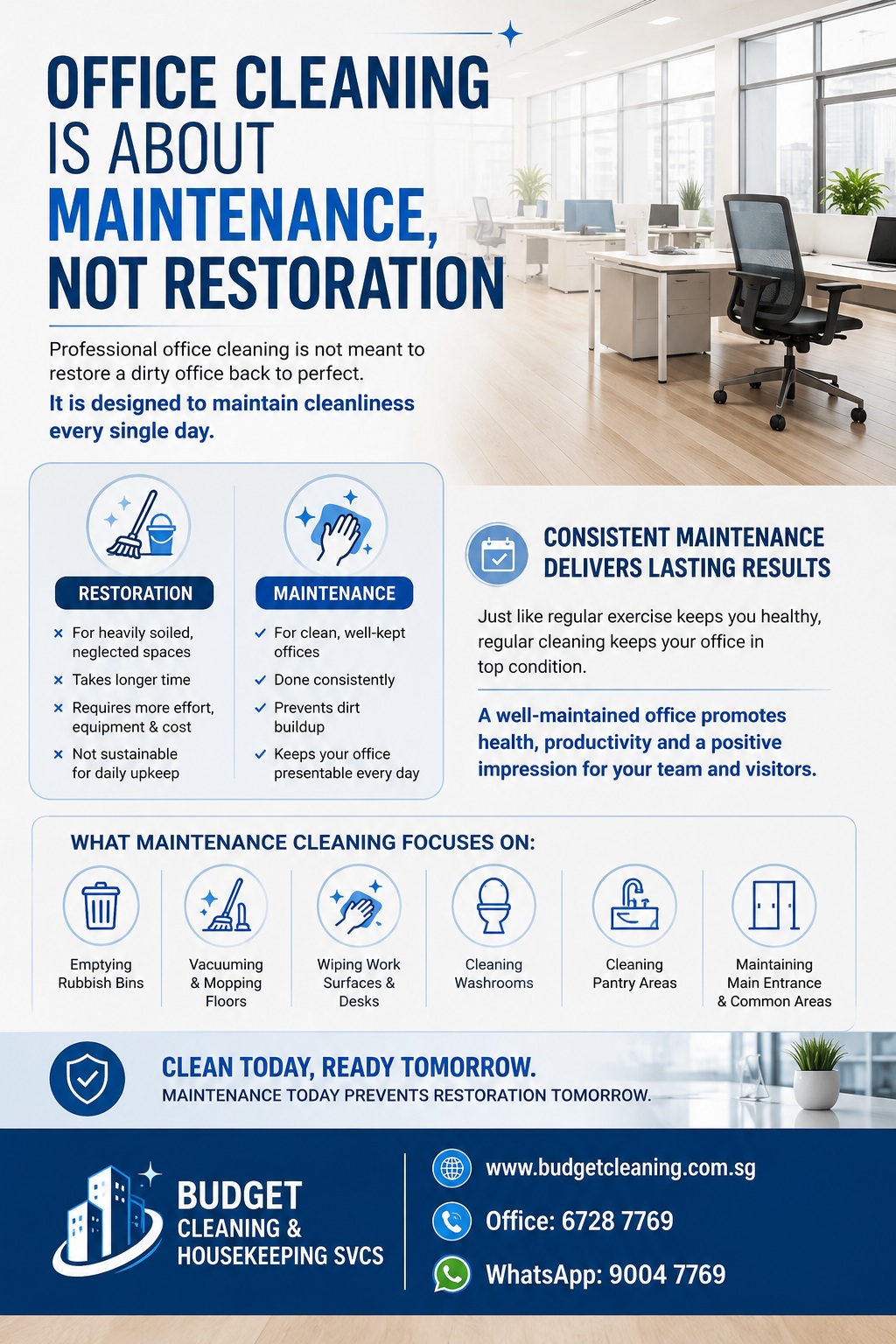
Key takeaway: Every routine cleaning visit is designed to maintain cleanliness and hygiene. More labour-intensive tasks—such as carpet shampooing, high-level dusting, upholstery cleaning and interior appliance cleaning—are best planned as periodic services rather than performed during every visit.
Final Thoughts
Professional office cleaning isn’t about fitting every possible task into a three-hour visit. It’s about making the best strategic use of the available time. When routine maintenance is carried out consistently, workplaces remain clean, hygienic, and welcoming without requiring every single visit to become an intensive deep clean.
The plans that promise to do everything at every visit usually end up rushing through the core tasks, leaving high-touch areas poorly sanitised.
The most effective commercial plans consistently prioritise the tasks that matter most to day-to-day operations and staff health.
Understanding this simple operational reality helps set realistic expectations, drastically improves long-term cleaning outcomes, and allows both clients and cleaners to align on the exact same goal—a clean, healthy, and highly productive workplace.
The Golden Rule of Commercial Cleaning
Whether your workspace is larger or smaller than our 800 sq ft baseline example, the rule remains: Good office cleaning isn’t measured by how many tasks are squeezed into a visit—it’s measured by how effectively the available time is used to maintain a consistently clean environment.
OFFICE CLEANING KNOWLEDGE SERIES
A Comprehensive Guide to Managing Workspace Logistics & Expectations
Part 1: What Can Really Be Cleaned in 3 Hours? You Are Here
Managing expectations and understanding exactly what tasks realistically fit into a routine commercial cleaning booking.
Part 2: How Often Should an Office Be Cleaned?
Choosing the ideal operational frequency based on your head count, client footprints, and corporate workspace layout.
Part 3: How Long Should Office Cleaning Take?
Demystifying the internal parameters commercial companies use to construct precise price quotes and time estimates.
Ready to Maximise Your Office Cleaning Budget?
Stop paying for unpredictable deep cleans. Get a highly efficient, custom-tailored maintenance schedule that keeps your workplace healthy, productive, and looking sharp every day.
✨ Budget Cleaning & Housekeeping Services — 18 Years of Trusted Office Maintenance
You May Also Like
9 Energy Saving Tips Singapore – Efficient Home, Effortless Savings
24/03/2026
Natural and Eco-Friendly Practices: 20 Expert Tips for a Healthier Home
05/03/2026