Info

Mould vs. Mildew: What’s the Difference?
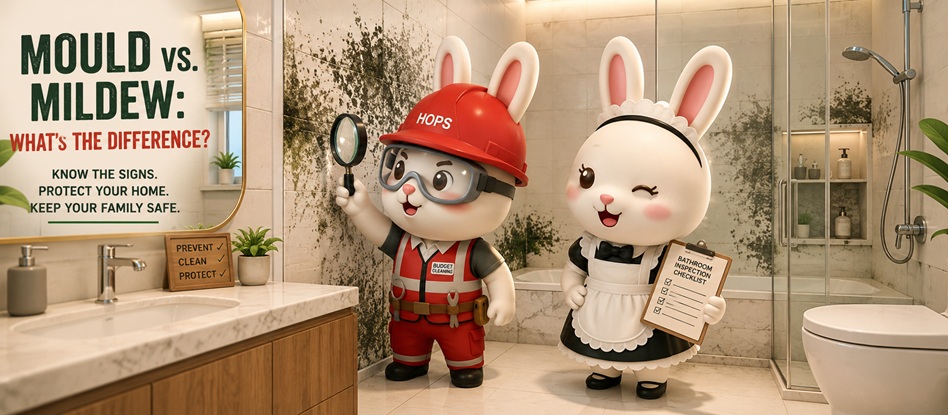
Difference Between Mould and Mildew: Key Home Facts
Scientific Classification, Structural Penetration & Health Risks Explained

Difference Between Mould and Mildew: 5 Critical Home Facts

When dealing with dampness in your home, understanding the exact difference between mould and mildew is essential for choosing the right cleanup approach. Not every dark stain in your bathroom is dangerous mould—and not every white patch is harmless mildew. Knowing the difference can help you choose the right cleaning method, protect your home, and prevent costly repairs.

Most homeowners use the terms mould and mildew interchangeably because both are fungi that thrive in damp, humid environments. While they share similar growth conditions, they differ significantly in their biology, how deeply they invade materials, the damage they cause, and their potential impact on indoor air quality.

A thin white film on your shower grout is usually very different from a black patch spreading across a damp ceiling. One is generally a surface issue that can often be cleaned away, while the other may indicate a deeper moisture problem requiring professional remediation.

This guide explains the scientific differences between mould and mildew, how to identify each one, and when it’s time to call a professional.

The Core Difference Between Mould and Mildew

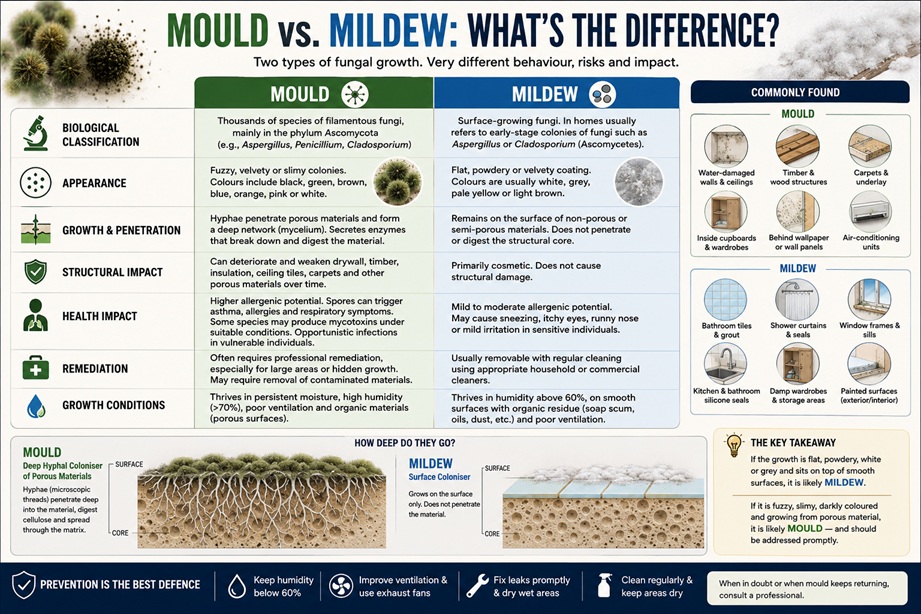
FeatureMouldMildew
Scientific ClassificationThousands of filamentous fungi (mainly Ascomycota and Mucoromycota)Surface-growing fungi, commonly early-stage colonies of Ascomycetes in homes
AppearanceBlack, green, blue, brown, orange, pink or whiteWhite, grey, pale yellow or light brown
TextureFuzzy, hairy, velvety or slimyFlat, powdery or velvety
Growth PatternForms branching hyphae and myceliumPrimarily grows on the surface
Penetration DepthInvades porous materials deeplySurface colonisation only
Common LocationsDrywall, timber, ceilings, carpets, insulationBathroom grout, silicone seals, shower curtains, painted surfaces
Structural DamageCan deteriorate porous building materials over timePrimarily cosmetic staining
Health ImpactHigher allergenic potential; some species may produce mycotoxinsMild to moderate allergic irritation
Removal DifficultyOften requires professional remediationUsually removable with routine cleaning
Primary CausePersistent moisture and water damageSurface moisture and high humidity

Scientific Profiles of Mould and Mildew

Although mould and mildew both belong to the Kingdom Fungi, they differ considerably in their biological structure and growth behaviour.

Mildew

Mildew is not a single species but a general term used for certain fungi that grow primarily on surfaces.

In Plant Pathology:
  • Powdery mildew (Erysiphaceae)
  • Downy mildew (Peronosporaceae, technically an oomycete rather than a true fungus)
In Residential Environments:

Usually refers to thin surface colonies of fungi such as:

  • Aspergillus
  • Cladosporium

These colonies typically appear as flat, powdery coatings that range from white and grey to pale yellow or light brown. Because mildew feeds mainly on organic residues such as soap scum, dust and oils, it rarely penetrates deeply into the material beneath it.

Mould

Mould is a much broader term covering thousands of species of filamentous fungi.

Common Indoor Species:
  • Aspergillus
  • Penicillium
  • Cladosporium
  • Alternaria
  • Chaetomium
  • Ulocladium

Stachybotrys chartarum (commonly known as black mould)

Unlike mildew, mould develops microscopic thread-like structures called hyphae, which intertwine to form a network known as mycelium. This network enables mould to penetrate porous building materials while digesting organic matter for nutrients.

Where Do Mould and Mildew Commonly Grow?

Mildew

Usually develops where moisture regularly condenses on smooth surfaces.

Common Locations:
  • Bathroom grout
  • Silicone sealants
  • Shower curtains
  • Window frames
  • Painted walls
  • Kitchen splashbacks

Mould

Usually develops where moisture penetrates building materials.

Common Locations:
  • Water-damaged drywall
  • Timber framing
  • Ceiling boards
  • Carpets and underlays
  • Behind wallpaper
  • Air-conditioning units
  • Wardrobes against external walls
  • Under sinks

Surface Structural Penetration

The most important distinction between mould and mildew isn’t their colour—it’s how deeply they invade the material.

Mildew: A Surface Coloniser

Mildew remains almost entirely on the surface. It commonly develops on:

  • Bathroom tiles
  • Shower screens
  • Silicone sealants
  • Window frames
  • Painted walls
Typical Penetration Depth
< 0.5 mm

Because it doesn’t digest the structural material beneath it, mildew is generally considered a cosmetic issue. Routine cleaning is usually sufficient to remove it.

Mould: A Deep Hyphal Coloniser

When spores land on porous materials such as drywall, timber or ceiling boards, they germinate and produce microscopic hyphae that penetrate beneath the surface, releasing enzymes capable of breaking down cellulose.

Approximate Penetration Depths:
MaterialTypical Penetration
Painted wall0.5–2 mm
Timber2–10 mm
DrywallSeveral mm
Carpet backingThrough fibres
Ceiling boardDeep into core

⚠️ By the time mould becomes visible, an extensive underground mycelial network may already be established. This is why simply wiping away visible mould often doesn’t solve the problem.

Why Bleach Doesn’t Solve Mould

One of the biggest misconceptions is that spraying bleach permanently removes mould.

While bleach can lighten or remove surface staining, it often fails to eliminate mould growing beneath porous materials. Without controlling moisture, mould almost always returns.

Professional mould remediation focuses on:

  • Identifying the moisture source
  • Eliminating leaks
  • HEPA vacuuming loose spores
  • Removing contaminated porous materials where necessary
  • Thorough drying
  • Preventing future moisture problems

Health Risks

Both mildew and mould release airborne spores. However, mould generally presents greater health concerns because larger colonies release significantly more spores and some species can produce mycotoxins under favourable conditions.

Health MetricMouldMildew
Allergic potentialHigherMild to moderate
Respiratory irritationCommonUsually mild
MycotoxinsSome species may produce themGenerally not associated
Opportunistic infectionPossible in immunocompromisedExtremely rare

Common Symptoms

  • Sneezing
  • Coughing
  • Runny nose
  • Wheezing
  • Itchy eyes
  • Skin irritation
  • Asthma flare-ups

Groups Most at Risk

  • Children
  • Elderly individuals
  • Pregnant women
  • People with asthma
  • Allergy sufferers
  • Individuals with weakened immune systems

Preventing Mould and Mildew

The most effective prevention strategy is controlling moisture.

Daily Habits

  • Keep indoor humidity below 60%
  • Use bathroom exhaust fans during showers
  • Open windows whenever practical
  • Dry wet surfaces promptly

Home Maintenance

  • Repair plumbing leaks immediately
  • Clean grout and silicone regularly
  • Improve airflow behind wardrobes and furniture
  • Service air-conditioning systems regularly

Frequently Asked Questions

While both organisms thrive in high humidity, the structural difference between mould and mildew dictates how you should manage them.

Is black mould always toxic?
No. Many mould species appear black, but only certain species produce mycotoxins under suitable environmental conditions. Regardless of colour, all visible mould should be removed because it releases airborne spores and allergens.

Can mildew turn into mould?
Not exactly. Mildew does not transform into mould. However, the damp conditions that allow mildew to grow can also support mould growth if moisture problems persist.

Can I clean mould myself?
Small areas of mould on non-porous surfaces may be cleaned safely using appropriate cleaning products and personal protective equipment. However, widespread mould, hidden mould, or mould caused by water damage should be professionally assessed.

Does mould always indicate a leak?

Not necessarily. Mould can also result from:

  • Poor ventilation
  • High humidity
  • Condensation
  • Inadequate insulation
  • Air-conditioning condensation

Conclusion

Although mould and mildew are both moisture-loving fungi, they exist on very different levels of severity.

Mildew

A surface coloniser that causes cosmetic staining and is usually removable with regular, superficial cleaning.

Mould

A deep hyphal coloniser capable of penetrating porous materials, weakening building components over time, and severely affecting indoor air quality through airborne spores, mycotoxins, or opportunistic infections.

The key isn’t simply identifying what you’re looking at—it’s understanding why it’s there. Addressing the underlying moisture source is essential. Without eliminating excess humidity, leaks, or condensation, even the most thorough cleaning will only provide a temporary solution.


Deep Cleaning Services

Keep Surface Mildew Under Control

Don’t let everyday moisture buildup turn into a massive headache. While heavy structural mould requires a specialist, our professional deep cleaning team is here to thoroughly scrub away stubborn surface mildew, wipe down high-humidity zones, and refresh your space before cosmetic staining takes over.
Book a Weekly Regular Cleaning

mould and mildew facts