UV Sanitization vs. Dry Steam vs. Hot Water Extraction: What Your Mattress & Sofa Actually Need
Mattress Cleaning Methods GUIDE
UV Sanitization vs. Dry Steam vs. Hot Water Extraction: What Your Mattress & Sofa Actually Need
When exploring different mattress cleaning methods for your home in Singapore after 18 years on the ground, we’ve heard it all….
Customers call up asking for a “steam clean,” “UV sanitisation,” or “water extraction,” assuming they are simply three different names for the same service.
They aren’t.
These mattress cleaning methods work in very different ways. More importantly, they solve different cleaning problems.
The Reality Check: If you are dealing with a heavily soiled, sweat-stained mattress, shining a UV-C lamp over it does not remove the accumulated dirt. On the other hand, using excessive water or heat on a delicate mattress without understanding its construction can create its own problems.
Choosing the Right Approach
So let’s cut through the marketing terms. Here is how an experienced professional looks at these three methods, what they actually do, and how to choose the right approach for your mattress or upholstery.
Industry Framework
The Pro’s Mental Model: Treat, Loosen, or Remove?
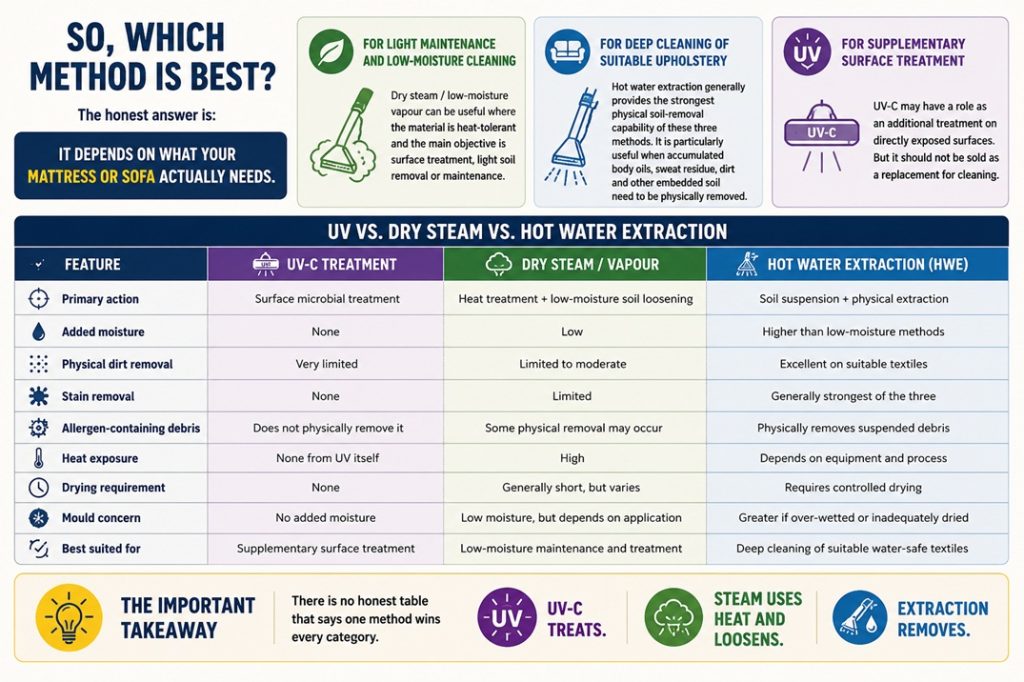
For the three mattress cleaning methods homeowners most commonly encounter, there is a simple way to understand what each one actually does:
UV-C Treatment = TREAT
UV-C is primarily a surface treatment. It can reduce susceptible microorganisms on directly exposed surfaces under appropriate conditions, but it does not physically remove dirt, dust or allergens.
Dry Steam / Vapour = LOOSEN & TREAT
Low-moisture vapour uses heat to treat surfaces and help loosen certain types of soil, while introducing considerably less liquid moisture than conventional wet cleaning.
Hot Water Extraction (HWE) = REMOVE
Hot water extraction uses a cleaning solution, appropriate agitation and vacuum recovery to physically remove suspended soil and contaminants from suitable textiles.
That distinction is important. Treating something is not the same as cleaning it. Loosening dirt is not the same as removing it. And physical extraction is not automatically suitable for every material.
A professional cleaning method must be matched to the item, its condition and the desired result.
Method Breakdown
Deep Dive Into the Three Mattress Cleaning Methods
UV-C Treatment: The Surface Add-On
The Reality
UV-C uses germicidal ultraviolet radiation to reduce susceptible microorganisms on directly exposed surfaces when the equipment delivers sufficient intensity and exposure time. But UV-C is not a vacuum cleaner, stain remover or extraction system. It does not physically remove dust, dead skin, body oils, sweat residue, food particles, pet fur, dander, or dust-mite debris. That distinction is often missed in marketing.
The Catch
Effectiveness depends on wavelength, intensity, exposure time, distance, and direct exposure. A mattress is not a flat laboratory surface; fibers, seams, folds, and padding obstruct the light. Reducing microorganisms also does not eliminate the physical debris left behind.
The Verdict
UV-C can be a useful supplementary treatment, but it should not be presented as a substitute for physical cleaning when dealing with accumulated dirt or sweat.
Dry Steam / Vapour: Low-Moisture Choice
The Reality
Professional low-moisture vapour systems produce high-temperature vapour while introducing substantially less liquid moisture. Heat helps loosen surface soils, soften oily residues, reduce odors, and provide thermal treatment. Low moisture, however, does not mean zero moisture as steam condenses on contact.
The Catch & Drying
Steam loosens grime without extracting it; without recovery, loosened soil remains inside. Heat-sensitive or specialized materials may also react poorly. In Singapore’s humid climate, lower moisture speeds up drying, but proper drying management remains necessary.
The Verdict
An excellent option for routine maintenance and minimal-moisture situations on heat-tolerant fabrics, but not a replacement for deep extraction.
Hot Water Extraction (HWE): Heavy-Duty
The Reality
Often mislabeled as “steam cleaning,” HWE follows an apply $\rightarrow$ loosen $\rightarrow$ extract process using a solution, agitation, and vacuum recovery. This physical removal effectively extracts body oils, sweat, food residue, and pet contamination from water-safe textiles.
The Catch & Limitations
Introduces more moisture, requiring strict control to avoid over-wetting, musty odours, and microbial growth in Singapore’s climate. Certain memory foams and latex constructions are sensitive to moisture and heat.
The Verdict
One of the most effective methods for deep physical soil removal on suitable water-safe textiles, entirely dependent on technician skill and technique.
What About Allergens and Dust Mites?
This is where the difference between sanitisation and cleaning becomes especially important. A mattress may contain a mixture of dust, skin flakes, body oils, dust-mite debris, pet dander, and other particulate matter.
Reducing microorganisms does not automatically remove these materials. Likewise, reducing or killing an organism does not mean that its physical remains or allergen-containing debris have disappeared.
Why Physical Removal Matters
That is why physical removal matters when the objective is to reduce accumulated dust and allergen-containing debris. For this purpose, thorough vacuuming and, where appropriate, extraction can play a much more important role than simply applying a surface treatment.
What About Stains and Body Sweat?
This is another area where the cleaning method matters. A mattress may look relatively clean while still accumulating body oils, sweat residue, skin flakes, dust, hair, cosmetic residue, and food or drink spills. Over time, these contaminants can contribute to discolouration and odour.
UV Cannot Remove Them
UV-C is not a physical soil-removal process and cannot lift embedded residues from your mattress.
Steam May Loosen Some
Heat can help soften or loosen certain soils, but loosening is not the same as physical removal.
Extraction Recovers Soil
When the material is suitable, hot water extraction has a major advantage in physically recovering suspended soil.
However, not every stain can be completely removed, particularly if it has chemically altered the fibre, permanently dyed the material, or damaged the underlying fabric. A professional cleaner should never promise that every stain will disappear.
How a Professional Decides What Your Home Needs
An honest, experienced cleaner will never give you a blanket answer such as “Every mattress must be steam cleaned” or “Everything must be extracted.” We look at the actual item and decide on an appropriate cleaning protocol.
1. What is the material?
We identify the fabric, upholstery construction, mattress surface and, where relevant, the underlying foam or filling.
Some materials tolerate water well, while others are much more sensitive to moisture or heat.
2. What is the condition?
We check for surface dust, heavy soil, body oils, sweat residue, staining, pet contamination, odours, previous damage, excessive moisture, and fabric wear.
The dirtier the item, the more important physical soil removal becomes.
3. What is the cleaning objective?
Whether you are looking for routine maintenance, surface refreshing, odour reduction, stain treatment, deep soil removal, dust elimination, or low-moisture cleaning, your goal changes the appropriate method.
4. What does the material allow?
A professional should never choose a cleaning method simply because it is the machine they happen to own. The material comes first.
Where manufacturer’s care instructions are available, they should always be taken into account.
5. What are the drying conditions?
This is especially crucial in Singapore. We factor in air-conditioning, cross ventilation, fans, air movement, dehumidification, room temperature, and remaining moisture.
A good extraction system should remove as much moisture as practical during the cleaning process.
The Summary
The Bottom Line
There is no magic cleaning button.
UV-C Treatment
Can treat an exposed surface, but it does not physically remove accumulated dirt.
Dry Steam
Uses heat and low moisture to loosen and treat surfaces, but lacks the flushing and recovery action of extraction.
Hot Water Extraction
Provides one of the strongest physical soil-removal methods for suitable water-safe textiles, paired with proper moisture control and drying.
The right professional does not simply sell you a particular cleaning technology. They look at the material, condition, cleaning objective and drying environment, and then select the method that makes the most sense.
After 18 Years in the Industry
Don’t choose the machine first. Choose the right mattress cleaning method for the material and the problem.
Expert Care for Your Home
Not Sure What Your Mattress or Sofa Actually Needs?
Skip the guesswork and gimmicks. With 18 years of hands-on experience in Singapore, we inspect your materials first and match them with the right professional treatment—no over-wetting, no empty promises, just honest results.
Trusted across Singapore for 18 years • Tailored protocols for every fabric