
How Often Should an Office Be Cleaned?
Building an Office Cleaning Schedule That Actually Works
Part 2: How Often Should an Office Be Cleaned?
Many businesses ask how often their office should be cleaned. The answer isn’t “every day” or “once a week”—it depends on how the space is used.
This guide explains how professional office cleaning schedules are planned, why different tasks are performed at different frequencies, and how a structured maintenance plan keeps workplaces cleaner, healthier, and more cost-effective over time.
The Blueprint of a Pragmatic Office Cleaning Schedule

Tailored Frequency
Moving past rigid “daily vs. weekly” mindsets to align with your office’s actual foot traffic and zone usage.

Healthier Workspaces
Targeting high-touch vectors systematically to disrupt germ transmission and reduce team sick days.

Cost Optimization
Preventing asset degradation through structured, rolling maintenance rather than expensive emergency overhauls.
Introduction
One of the most common questions we receive is:

“How often should our office be cleaned?”
Unfortunately, there isn’t a one-size-fits-all answer.

The Small Boutique Office
A small footprint with five employees may only require a thorough cleaning once a week to maintain pristine conditions.

The High-Traffic Hub
A bustling headquarters with thirty staff, constant external visitors, and heavy pantry usage drastically benefits from dedicated daily cleaning.
A Shift in Perspective
Rather than asking “How often should we clean?”, a better question is:
“What needs cleaning, and how quickly does it become dirty?”
The Zone & Cadence Principle
Professional office cleaning schedules are built around this simple principle. Understanding how different spaces accumulate dirt allows for strategic allocation.
Critical zones that become compromised every single day.
General operational areas needing a steady, rotational refresh.
Deep maintenance, specialized surfaces, and low-impact zones.
 This strategic granularity optimizes budgets while maintaining an immaculate, healthy workplace.
Routine Maintenance vs. Periodic Deep Cleaning
Deconstructing the biggest operational misconception in workplace & office cleaning.
 The Common Misconception
Assuming every single cleaning visit must encompass every possible deep-cleaning task.
In reality, high-efficiency professional office cleaning schedules systematically segregate work into two distinct operational categories. Let’s look at the first and most critical tier:

Routine Maintenance
Core Foundation
Routine maintenance keeps the workplace consistently clean, professional, and hygienic. These are the highly visible, critical tasks that employees and clients notice the second they step into the office.
Essential Tasks Include:

Vacuuming and mopping floors

Emptying rubbish bins & recycling

Cleaning and sanitising washrooms

Wiping down pantry & kitchen surfaces

Dusting accessible furniture & desks

Sanitising frequently high touchpoints
 Baseline Rule: These baseline operations prevent micro-dirt and pathogens from accumulating, forming the absolute foundation of any functional cleaning schedule.
A Simple Office Cleaning Schedule
Although every office is different, most workplaces benefit immensely from a structured, tiered maintenance plan. Here is a definitive operational example.

Every Visit
Crucial tasks that maintain baseline workplace hygiene and daily presentation.
 These are the core operational touchpoints that employees notice immediately if they are missed.
Rotational
Slower dirtying zones integrated seamlessly into weekly visits.
 Rotating these tasks maintains top-tier cleanliness without spiking daily billable hours.

Quaterly Maintenance
Targeting areas that gradually accumulate grit and grime.
 Monthly attention prevents aesthetic degradation and structural build-up.

Every 6–12 Months
Restorative, industrial-grade specialty care interventions.
 Asset Protection: This level of care dramatically extends the lifespan of expensive office finishes.
Factors That Influence Cleaning Frequency
No two offices operate the same way. Cleaning schedules should reflect how the workplace is actually used.

Number of Employees
More employees mean increased foot traffic, rapid rubbish accumulation, and more frequent washroom and pantry usage.

Visitor Traffic
Reception areas and meeting rooms frequently used by clients demand higher-frequency attention than back-office private suites.

Pantry Usage
A simple coffee station requires minimal upkeep. A full communal kitchen where lunches are prepared or eaten daily needs rigorous maintenance.

Flooring Type
Carpeted offices require systematic daily vacuuming, whereas hard floor surfaces demand disciplined, regular vacuuming & mopping (more time needed) in high-traffic paths.

Industry-Specific Priorities
Different sectors command highly specialized operational focuses.
| Business Type | Typical Cleaning Priority |
|---|---|
| Corporate Office | Workstations, meeting rooms, shared washrooms |
| Tuition Centre | Classrooms, student desks, high-use washrooms |
| Medical Clinic | High-touch vectors, infection control, sterile waiting zones |
| Retail Shop | Customer front-of-house, display flooring, fitting rooms |
| Co-working Space | Hot desks, communal pantry, meeting booths, washrooms |
Our Practical Cleaning Frequency Guide
Based on our experience serving businesses across Singapore, these recommendations provide a practical balance between workplace hygiene, operational needs and cost-effectiveness.
| Office Type & Typical Usage | Recommended Frequency | Why This Works |
|---|---|---|
| 💻 Small Office 5–10 employees, light visitor traffic | 1–2 visits per week | Ideal for hybrid workplaces or offices with lighter daily occupancy. Regular maintenance keeps dust, rubbish and washroom usage under control while remaining budget-friendly. |
| 🏢 Medium Office 10–25 employees | 2–3 visits per week | A practical balance for most Singapore SMEs, helping maintain clean workspaces, pantries and washrooms despite steady daily office activity. |
| 🚶 Busy Office Higher occupancy or frequent client visits | 3–5 visits per week | More people create more rubbish, heavier washroom usage, additional fingerprints and faster floor wear. More frequent maintenance keeps the office consistently presentable. |
| 🚀 High-Traffic Workspace Co-working spaces, customer-facing businesses and shared offices | Daily cleaning + Periodic deep cleaning | Daily cleaning maintains presentation and hygiene, while scheduled deep cleaning removes accumulated dirt and grime that routine maintenance cannot fully address. |
📊 Office Cleaning Frequency at a Glance
Prefer a quick reference? This infographic summarises our recommended cleaning frequencies for different office environments and serves as a practical guide when planning your workplace cleaning schedule.
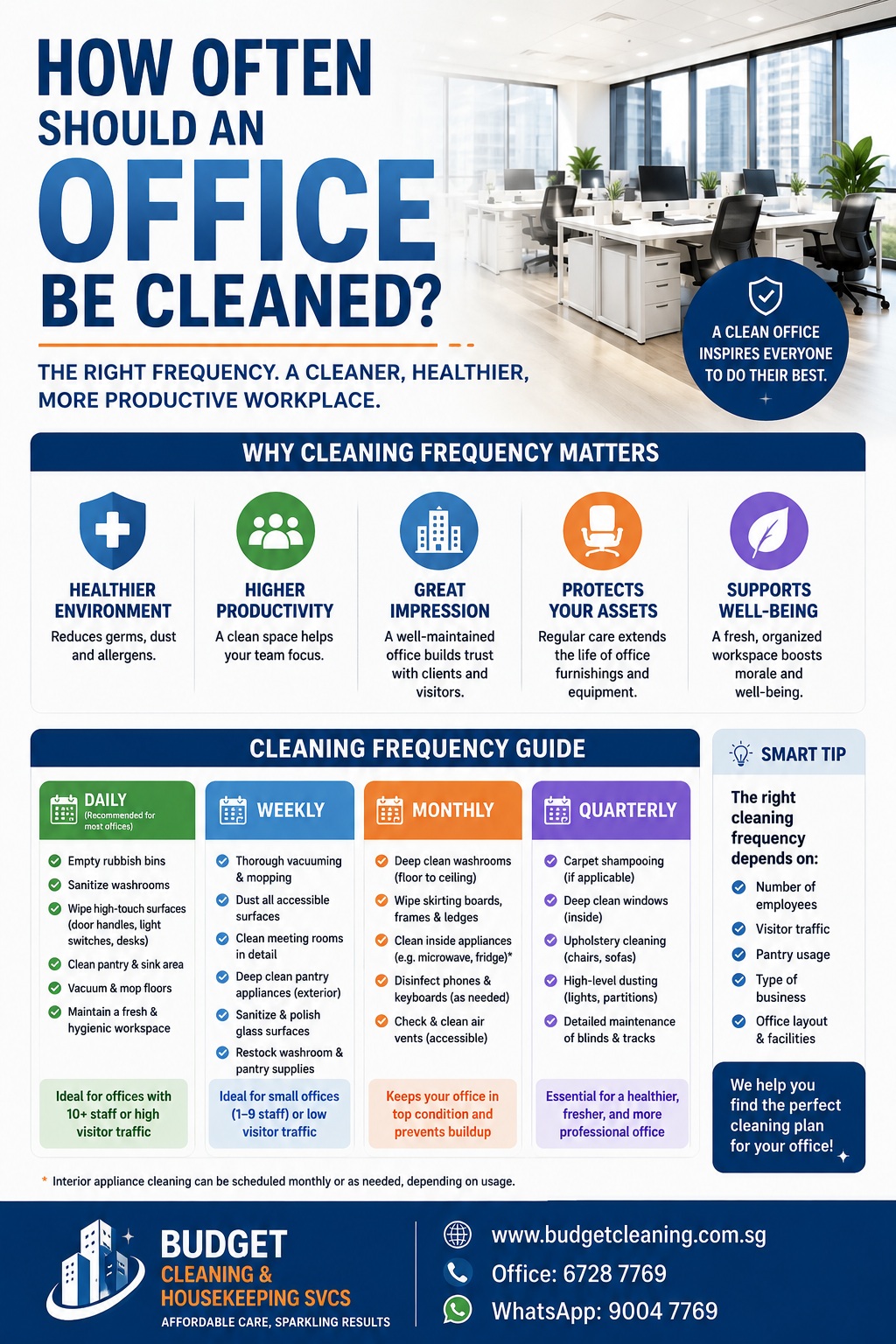
💾 Tip: Save or share this infographic with your office manager or facilities team as a handy reference when reviewing your office cleaning schedule.
💡 Every office is different. Treat this guide as a practical starting point rather than a fixed rule. The ideal cleaning frequency depends on your occupancy, visitor traffic, pantry usage, office layout and desired cleaning standard.
Optimise Your Workplace Management
Ready to Build a Cleaning Schedule That Actually Works?
Stop overpaying for arbitrary visits. Let our experts build a bespoke, data-driven maintenance blueprint tailored specifically to your office layout, occupancy density, and budget.

Free Site Assessment
A comprehensive visual audit of your custom workspace zones.
Customized Quotes
Transparent, itemised baseline pricing with no hidden costs.

 Zero obligations. Transparent professional diagnostics within 24 business hours.


