
How Long Should Office Cleaning Take?
Step 2: Assessing the Cleaning Workload
Once the workplace is understood, the next step is estimating the amount of work involved. Professional cleaning companies consider several factors before recommending the appropriate cleaning hours. To accurately estimate how long should office cleaning take for a unique corporate space, several variables must be evaluated beyond floor area alone.
 Number of Employees
More employees generally mean:
- More workstations
- More rubbish
- More pantry usage
- More washroom usage
- More high-touch surfaces
Occupancy often has a greater impact on cleaning time than floor area.
 Office Layout
Open-plan offices are generally quicker to clean than offices divided into multiple enclosed rooms. Additional offices, meeting rooms and glass partitions all increase cleaning time.
 Visitor Traffic
Businesses that regularly receive clients usually require more attention in reception areas, meeting rooms, entrances and shared spaces.
 Pantry Usage
A pantry used only for making coffee requires relatively little maintenance.
A pantry where employees prepare and eat meals every day requires considerably more attention due to food spills, grease, crumbs and increased rubbish.
 Number of Washrooms
Washrooms are among the most labour-intensive areas in any workplace. An office with multiple washrooms will naturally require more cleaning time.
 Flooring Type
Different flooring materials require different cleaning methods. Carpeted offices require thorough vacuuming, while hard floors require sweeping and mopping. Furniture layout also affects how efficiently floors can be cleaned.
 Furniture Density
Cleaning around rows of desks, office chairs and storage cabinets takes considerably longer than cleaning open spaces. More furniture means more detailing and more obstacles for vacuuming and mopping.
 Clutter
Professional office cleaners avoid moving confidential documents, electronics and personal belongings unnecessarily. When desks are cluttered or boxes are stored on the floor, cleaners can only clean accessible areas.
A tidy office allows the allocated cleaning time to be spent on cleaning—not navigating around obstacles.
Step 3: Understanding How Cleaning Time Is Actually Used
One common misconception is that every minute of a cleaning booking is spent actively vacuuming, mopping or wiping surfaces. In reality, professional office cleaning involves much more than the visible cleaning itself.
Every visit includes preparation before cleaning begins and wrap-up tasks after the cleaning has been completed. These activities are essential for delivering a safe, efficient and professional service, even though they are often invisible to the client.
⏳ Before Cleaning Begins
Before the first desk is wiped or the first floor is vacuumed, cleaners typically need to:
- Sign in with building security or reception (where required).
- Unload cleaning equipment and supplies from the vehicle.
- Transport equipment through loading bays, cargo lifts and commercial corridors.
- Assemble cleaning tools and prepare equipment.
- Dilute cleaning solutions safely according to the manufacturer’s instructions.
- Review site-specific instructions or any priority areas requested by the client.
✅ After Cleaning Is Completed
Once the core cleaning tasks are finished, there is still important operational work before the cleaner leaves.
- Dispose of rubbish at the building’s designated refuse collection point.
- Clean, rinse and sanitise used cleaning tools.
- Pack equipment and chemicals safely.
- Return all equipment back to the vehicle.
- Complete service records or report any maintenance issues identified during the visit.
🚰 Not Every Office Has Its Own Water Supply
A logistics factor that is often overlooked is access to water. Many office units in Singapore do not have a dedicated utility sink suitable for commercial cleaning.
Instead, cleaners may need to walk to the building’s shared janitor room to fill mop buckets, prepare fresh cleaning solutions and rinse microfibre cloths. Depending on the building layout, this may involve travelling across long corridors or between floors several times during a visit.
Changing mop water regularly is an important hygiene practice that helps minimise cross-contamination. Where repeated trips are required, this naturally becomes part of the overall cleaning time.
📊 How Professionals Determine Cleaning Time
Before recommending cleaning hours, experienced cleaning companies assess much more than just office size. Occupancy, office layout, washrooms, pantry usage, visitor traffic and the agreed scope of work all influence the amount of time required to deliver a consistent cleaning standard.
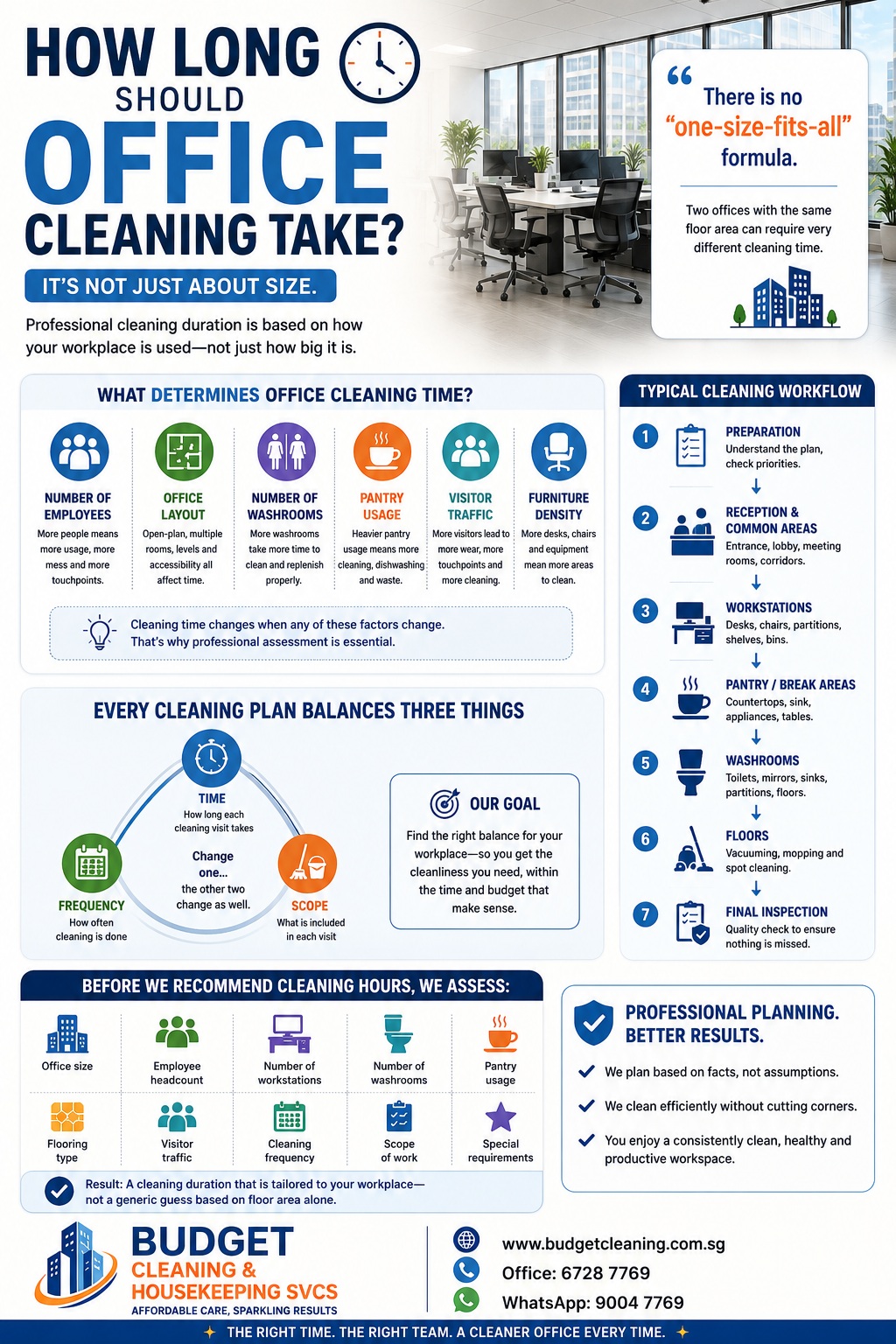
💾 Tip: Save or share this infographic when comparing office cleaning quotations. It explains why two offices of the same size can require very different cleaning durations.
💡 Did You Know?
In many commercial buildings, cleaners can spend 10–20 minutes per visit on preparation and wrap-up activities alone. This includes security check-ins, transporting equipment, preparing cleaning solutions, accessing shared utility rooms, disposing of rubbish and packing up safely before leaving. Although these tasks are rarely seen, they are an essential part of delivering a professional cleaning service.
Step 4: Cleaning During Office Hours Takes Longer
Many businesses prefer office cleaning to be carried out during working hours, and we’re happy to accommodate this whenever possible. However, cleaning an occupied office is very different from cleaning an empty one.
Our cleaners work around your business operations, which means they may need to adjust their workflow to minimise disruption to your team. For example, they may need to:
 Operational Adjustments in an Occupied Office:
- Return later to clean occupied workstations.
- Wait until a meeting has finished before cleaning the meeting room.
- Pause vacuuming near staff who are on phone or video calls.
- Delay mopping busy walkways.
- Avoid interrupting confidential discussions or client meetings.
These adjustments help maintain a comfortable working environment, but they also mean the cleaning process is generally less efficient than cleaning an empty office.
 After Office Hours
 During Office Hours
 DID YOU KNOW?
Cleaning before/after office hours often allows cleaners to complete the same scope of work more efficiently because they have uninterrupted access to the entire workplace.
Step 5: How Long Should Office Cleaning Take to Match Your Expectations?
From time to time, we’re asked whether a large office can be maintained with just a one-hour cleaning visit. There’s nothing wrong with asking the question. However, expectations need to match the available cleaning time.
A cleaner booked for one hour has only 60 minutes available. Within those 60 minutes, they may be expected to:
 The 60-Minute Task Challenge:
For many offices, this simply isn’t enough time to complete every task thoroughly.
Professional office cleaning isn’t about working faster. It’s about allowing enough time to consistently deliver the agreed scope of work.
DID YOU KNOW?
Adding another cleaner doesn’t always cut the cleaning time in half.
In many small and medium-sized offices, certain tasks can only be carried out by one person at a time. Only one cleaner can comfortably vacuum a narrow corridor or clean a reception counter. In occupied offices, cleaners may also need to wait for meeting rooms to become available or work around employees at their desks. The most efficient cleaning plan isn’t simply about sending more cleaners—it’s about allocating the right amount of time and manpower for the office layout and agreed scope of work.
Why Do Many Cleaning Companies Have Minimum Booking Hours?
Customers sometimes wonder why commercial cleaning companies have minimum booking durations. The reason is simple: a cleaner’s work involves much more than the time spent inside your office.
Every visit also includes:
 Travelling between sites
 Transporting equipment and supplies
 Preparing and packing away equipment
 Proper waste disposal
- Building access and security procedures
For very short jobs, the time spent travelling and preparing can approach—or even exceed—the actual cleaning time. Minimum booking durations help ensure every visit is practical, efficient and worthwhile for both the client and the cleaning team.
Step 6: Comparing Quotations Fairly
When comparing office cleaning quotations, don’t focus solely on the final price.
Instead, compare what is actually being offered side-by-side, example of a 2500sqf office space:
 Allocated Cleaning Time
 Clean Main Entrance
 Reception & Meetings
 Workstations
 High-Touch Sanitising
 Final Quality Inspection
A lower quotation isn’t necessarily better value.
In many cases, the difference isn’t simply the hourly rate—it is the amount of time available to complete the work. With fewer allocated hours, cleaners naturally need to prioritise the most essential tasks, while more detailed cleaning may be reduced, rotated, or omitted.
When comparing quotations, look beyond the final price tag. Compare exactly what tasks are included, how often each item is performed, and verify whether enough operational time has been allocated to achieve the clean, safe workspace standard you expect.
Ready to Find the Perfect Balance for Your Office?
Don’t guess your cleaning hours or accept an unrealistic quote. Let our experienced team assess your layout, occupancy, and specific workplace goals to tailor a custom schedule that works flawlessly for your business.
 Request an Office Quotation
 Speak with an Expert
No obligation, transparent parameters, and 18+ years of trusted corporate space management across Singapore.


